
Scar Care After Surgery
A scar is a normal part of healing. Even with excellent surgical technique, every incision will leave some degree of scar. The good news is that how you care for an incision during the months after surgery can influence how that scar ultimately looks and feels. My goal is to give you a simple, evidence-based approach to scar care following orthopedic surgery.
Your First 2 Weeks:
The First 48 hours (For most arthroscopic surgeries/open knee surgeries).
Keep your surgical dressing in place for 48 hours, unless you are given different instructions.
After 48 hours, you may remove the outer dressing.
You may shower once the dressing has been removed.
Do not soak or submerge the incision in a bathtub, swimming pool, hot tub, or other body of water until you have been cleared to do so.
Your incision will generally be closed with absorbable Monocryl® sutures and covered with Steri-Strips®.
Leave the Steri-Strips alone
Your Steri-Strips should generally remain in place until your postoperative appointment, typically 10–14 days after surgery.
Do not pull them off early, even if they begin to loosen at the edges. If they fall off that is ok.
Once the incision is fully healed and your Steri-Strips have been removed, you can begin a dedicated scar-care program.
Important: Do not apply silicone gel, scar creams, or other products directly to an open wound, draining incision, or area with an active scab until specifically instructed it is ok to do so.
Silicone Scar Gel
My preferred option for most orthopedic surgical scars
Silicone gel is one of the best-studied nonsurgical treatments for preventing and improving postoperative scars.
Clinical studies and systematic reviews have found that silicone products can improve characteristics such as:
Scar redness and pigmentation
Scar thickness
Scar firmness
Scar pliability
Itching and discomfort
A systematic review and meta-analysis of randomized trials found that topical silicone gel significantly improved scar pigmentation, height, and pliability compared with placebo or no treatment.
International scar-management guidelines have also identified silicone gel and silicone sheets as first-line, noninvasive options for preventing and treating problematic scars.
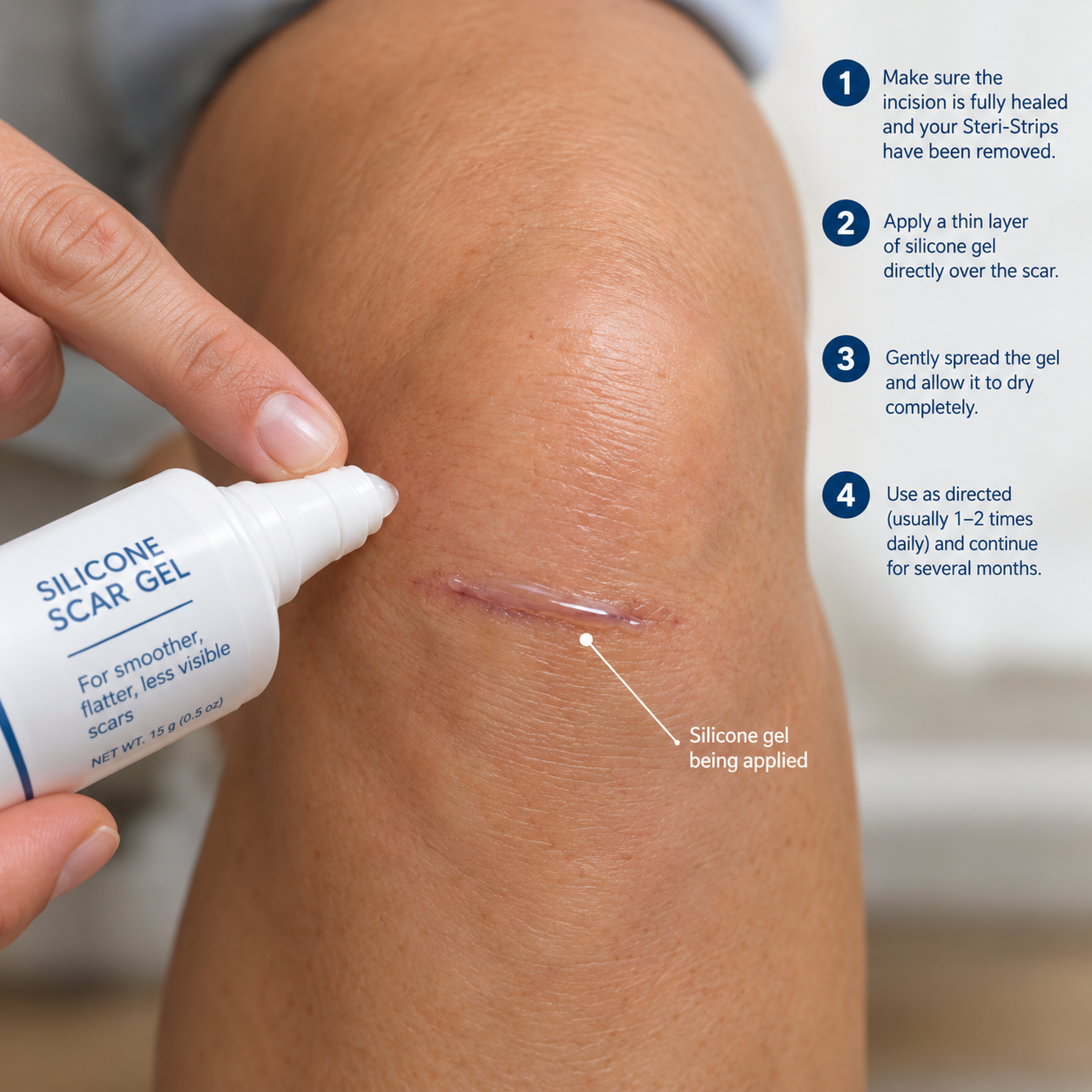
How to use silicone gel
Once your incision is completely healed and your Steri-Strips have been removed:
Wash and dry the area.
Apply a very thin layer of silicone gel directly over the scar.
Allow it to dry completely.
Follow the product's instructions regarding frequency and duration.
Typically appyling every 12 hours
Continue consistently for several months.
Consistency is more important than applying a thick layer.
Silicone scar products
I recommend looking for a product that contains medical-grade silicone rather than simply choosing a product marketed as a "scar cream."
Examples patients may consider include:
Other medical-grade silicone scar gels
Some links on this page may be affiliate links. If you purchase through an affiliate link, I may receive a small commission at no additional cost to you. My recommendations are based on the product category and available evidence; an affiliate relationship does not change my clinical recommendations.
Protect Your Scar From the Sun
Sun exposure can make a scar darker and more noticeable.
New scars are particularly susceptible to changes in pigmentation from ultraviolet exposure.
For this reason, I recommend protecting your surgical scar from direct sunlight for at least 6–12 months after surgery, particularly during the first several months.
When the scar will be exposed:
Cover it with clothing when practical.
Use a broad-spectrum SPF 30–50+ sunscreen once the incision is completely healed.
Reapply sunscreen when spending prolonged time outdoors.
Be especially careful with scars on the shoulder, knee, arm, or other areas that are routinely exposed to sunlight.
Sun protection is particularly important for patients who are prone to hyperpigmentation.
Broad-spectrum sunscreen is recommended as part of postoperative skin care because UV exposure can contribute to persistent pigmentation changes.
Scar Massage
Once your incision is completely healed and your Steri-Strips have been removed, gentle scar massage can be added to your routine.
Scar massage may help:
Improve scar pliability
Decrease tightness
Decrease sensitivity
Improve mobility of the scar relative to the underlying tissues
Potentially improve the appearance of a mature scar
The evidence for scar massage is not as strong or consistent as the evidence for silicone. Studies use widely different techniques and treatment schedules, and the quality of evidence is variable.
How to massage your scar
Once your incision is fully healed:
Step 1: Place a fingertip over the scar.
Make sure to use clean/washed hands prior to massaging incision site.
Step 2: Apply gentle pressure and move the skin in small circles.
Step 3: Progress to gently moving the scar from side to side and up and down.
Step 4: Spend approximately 3–5 minutes working along the entire scar.
This can be performed once or twice per day.
Massage should feel like gentle pressure—not pain.
If the scar becomes increasingly red, swollen, painful, or irritated, stop and contact our office.
Red Light Therapy
An optional adjunct—not a replacement for silicone
Red light therapy, also called photobiomodulation (PBM) or low-level light therapy, is an emerging treatment for wound and scar healing.
The theory is that specific wavelengths of red and near-infrared light may influence cellular metabolism, inflammation, collagen remodeling, and tissue repair.
There is growing clinical evidence suggesting that photobiomodulation may improve certain characteristics of postoperative scars.
A 2026 scoping review identified seven clinical studies involving 297 patients evaluating red or near-infrared photobiomodulation for burn, hypertrophic, and postsurgical scars. The studies reported improvements in some measures of scar thickness, color, induration, elasticity, and patient-reported scar scores. However, the studies were relatively small and used substantially different wavelengths, treatment doses, and treatment schedules.
What does this mean for you?
I consider red light therapy promising but not yet as well established as silicone therapy.
If you are interested in using it:
Choose a device that provides documented wavelengths and treatment parameters.
Red light in the approximately 630–670 nm range and near-infrared light around 800–850 nm are among the wavelengths studied in clinical research.
Follow the manufacturer's treatment schedule.
Do not assume that a more powerful device or longer treatment is necessarily better.
Photobiomodulation appears to have a favorable safety profile in the available studies, but optimal treatment parameters have not yet been established.
An important distinction
Red light therapy should currently be considered an adjunct to, rather than a replacement for:
Good wound care + silicone + sun protection + appropriate scar massage.
What About Vitamins and Supplements?
Patients frequently ask whether vitamins or supplements can make their scars heal better.
There is an important distinction between supporting normal wound healing and proving that a supplement produces a better-looking final scar.
I do recommend each of the supplements listed below, however there is no strong evidence that routinely taking each of the vitamins listed below can produce a cosmetically superior scar.
Vitamin C
Vitamin C is important for collagen synthesis and normal wound healing.
Patients with inadequate nutritional intake or vitamin C deficiency may benefit from correcting that deficiency.
Vitamin D
Vitamin D plays an important role in immune function and tissue health. Vitamin D deficiency has been associated with poorer outcomes in some wound-healing populations.
Zinc
Zinc is important for normal immune function and wound healing, and zinc deficiency can impair wound healing.
The bottom line
Eat a healthy, protein-rich diet and correct nutritional deficiencies when they exist.
There is currently insufficient evidence to recommend routine high-dose vitamin or mineral supplementation solely for the purpose of improving the appearance of a surgical scar.
What About Vitamin E?
You may have heard that applying vitamin E to a surgical scar can improve its appearance.
The evidence does not support this recommendation.
In a clinical study evaluating topical vitamin E after skin surgery, vitamin E did not improve scar appearance and caused contact dermatitis in a substantial proportion of patients.
For this reason, I do not recommend routinely applying topical vitamin E to surgical scars.
Silicone gel is a better-supported option.
When to Contact Our Office
Scar care is intended for a normally healing incision.
Please contact our office if you develop:
Increasing redness or warmth
Drainage
Opening of the incision
Increasing swelling
Fever
Increasing pain
A rapidly enlarging or raised scar
Any concern that your incision is not healing normally
When in doubt, contact our office before applying a new product to your incision.
Medical Disclaimer
This information is provided for educational purposes and is intended to supplement—not replace—the postoperative instructions provided by your surgical team. Your individual wound-care instructions may differ depending on the procedure performed, your medical history, and how your incision is healing.
If you have questions about your specific incision or scar, please contact our office or your treating physician.